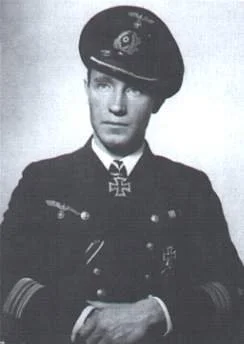
In April 1942, U-333 was stalking a British tanker in the mid-Atlantic, lining up for a torpedo attack. The crew had chased the tanker all afternoon and as the sun went down, they finally had a clear torpedo shot. The first torpedo launched. Nothing happened. A second torpedo missed the target.
The perplexed crew of U-333 submerged to reload the torpedo bays. As the U-boat reached periscope depth, the tanker was perfectly visible in bright moonlight. U-Boat Captain Peter Cremer squinted through the periscope to estimate the range for another torpedo attack. Suddenly the periscope went black.
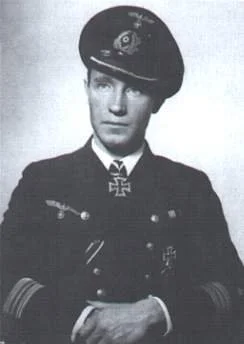
Peter-Erich Cremer
A hideous screeching of grinding metal filled the air. The collision shook the tanker violently and the U-boat pitched around like a toy. Water flooded into the control room. It was clear that the U-boat’s pressure hull had been ripped open. The U-boat had to surface to avoid flooding and sinking with all hands.
Upon surfacing, Cremer discovered that the conning tower hatch wouldn’t open. Crew members climbed out the galley hatch to assess the damage. They were horrified by what they saw. The British tanker had hit the bow of the U-boat, twisting the nose to port. The tanker’s propellers chopped into the U-boat’s bridge, ripping it off. The steel casing of the conning tower was dented, the periscope had snapped off, and the torpedo aiming sights were gone. The bow torpedo bays were jammed shut.
The British tanker had also been ripped open, as if a can opener had cut down the entire side of the vessel. However, the British tanker was double-hulled (as all tankers are today) and it continued its journey to Britain, where it was greeted with acclaim.
The U-boat crew, meanwhile, made sufficient repairs to remain seaworthy, and continued their patrol to the Florida coast. U-333 arrived off Florida on May 3, 1942, joining other U-boats attacking U.S. shipping routes along the Atlantic coast and into the Caribbean.
It was a great time to serve on a U-boat because the U.S. had not imposed a blackout after declaring war on Germany in December 1941. For the next six months, coastal cities remained brightly lit at night. Florida businesses claimed they needed to keep the lights on to avoid losses during the tourism season. But the coastal lights illuminated ships along the coastal shipping lanes. For the U-boats, it was like shooting fish in a barrel. Most of the tonnage sunk by U-boats occurred during this time. The U-boat crews called it “the happy time”.
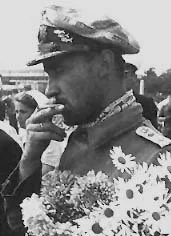
Cremer after a patrol
The happy time didn’t last. By the end of 1942, coastal defenses were sinking U-boats and Atlantic convoys were escorted by British and American aircraft carriers, destroyers and corvettes. New high frequency radio signals were able to pinpoint the location of U-boats and more effective depth charges meant fewer U-boats survived.
Peter Cremer survived. He ascribed his survival to experience, learning from his mistakes, and luck. In October 1942, U-333 was attacked by a corvette. There was no time to dive, so Cremer ordered a hard turn to starboard and full speed ahead. The maneuver saved the boat but exposed everyone on the bridge to machine gun fire. Cremer was the last man to leave the bridge after helping his wounded crew members to get below. One crewman slipped overboard and was never recovered.
Cremer had shell splinters in his arm, his breastbone and his left eye was gummed shut with blood from a head wound. But he continued giving orders, changing direction to try to escape. The corvette and the U-boat circled each other, getting closer and closer until the corvette rammed the U-boat. With the U-boat leaking at the stern where it had been rammed, Cremer decided to surface to save the crew. He was able to escape in the dark because the corvette had also received extensive damage.
Cremer received the Knight’s Cross for his bravery and spent months in the hospital recuperating from his extensive injuries. During his recovery, he was assigned to desk duty on Admiral Donitz’s staff. From his desk, he tracked the U-boat losses of friends and colleagues. In April 1943, he returned to command of U-333.
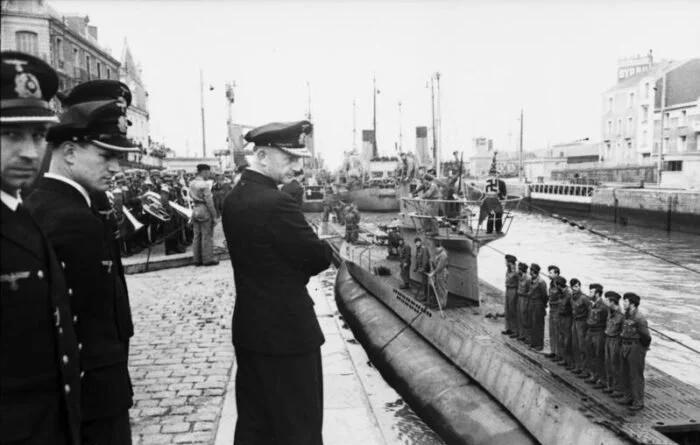
Karl Donitz
Cremer’s experience and luck became legendary in the U-boat fleet and crewmen wanted to join him. Cremer chose candidates based on their peacetime skills, such as electricians, plumbers, and mechanics because a U-boat crew needed to be able to repair damage caused by depth charges and airplane strafing attacks. If a prospective crew member had also played football (i.e., soccer), they were likely to be picked by the Old Man, because Cremer believed that individuals who played team sports would find it easier to develop team spirit.
Team spirit was critical on the Type VII U-boat which was cramped. The crew was divided into watches (shifts) with part of the crew on duty and part of the crew sleeping, since there weren’t enough bunks for everyone. The boat had one toilet which had to be emptied by a hand pump, a difficult feat given the outside pressure on the hull. The toilet also doubled as storage space for canned food. There were no showers because fresh water had to be saved for cooking and drinking.
Cremer left U-333 on July 10, 1944 (it sank with no survivors on July 31st) to take command of U-2519, a new Type XXI electro-boat. It was luxurious compared to the Type VII, having two toilets, a shower, and a bunk for each crewman. It was fast, difficult to detect when submerged, and could dive deeper than any depth charges. Cremer and others believed these boats could have made a difference to the naval war if they had been developed earlier in the war.
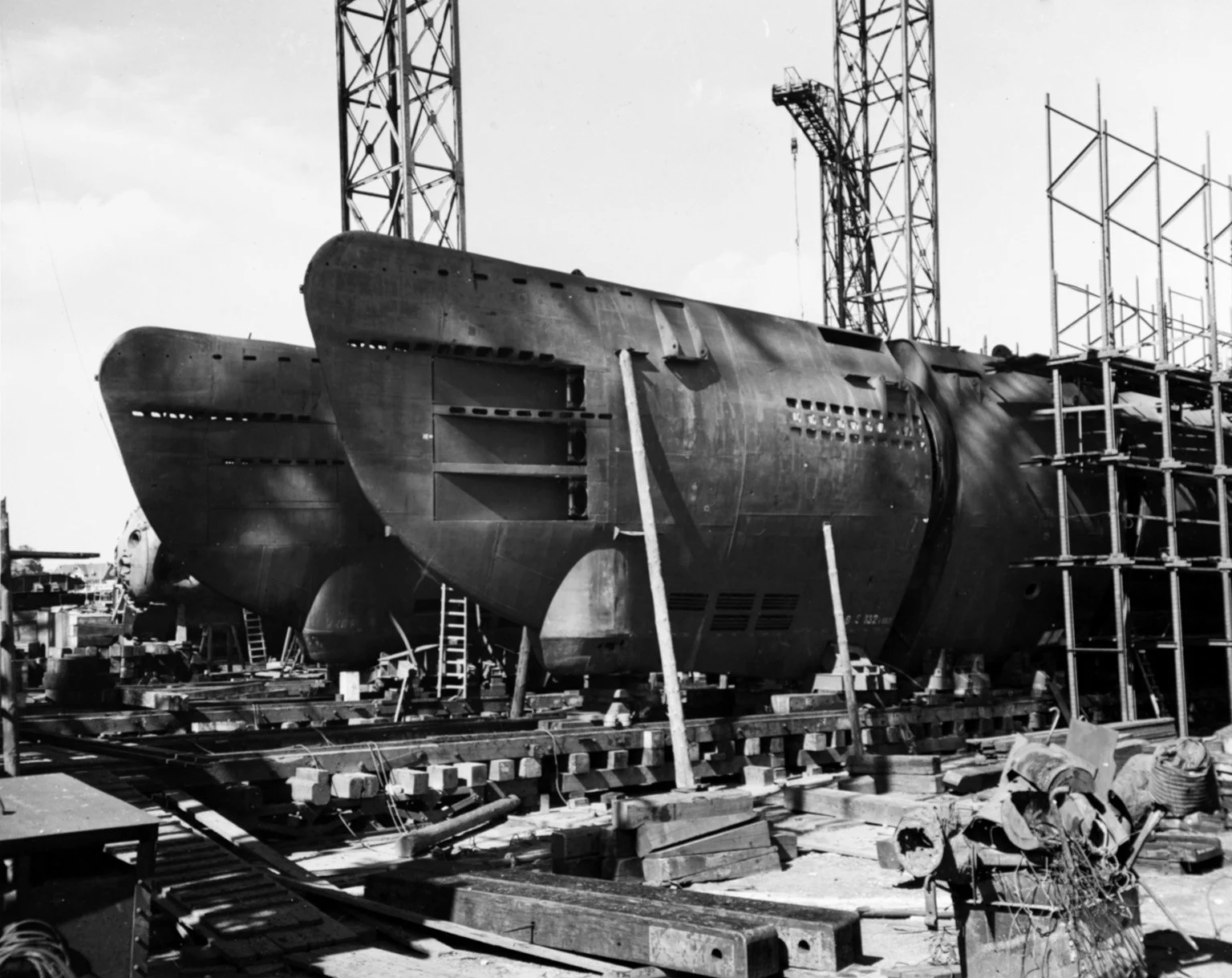
Type XXI u-boats under construction
Cremer ended the war commanding the naval guard protecting Admiral Donitz, the final leader of the Third Reich. He was the only U-boat commander to survive more than 2 years in the Atlantic and was the longest serving U-boat commander when the war ended in May 1945. Approximately 39,000 men served on U-boats and only about 10,000 survived the war.
With such a high casualty rate, it seems surprising that the U-boat service always had plenty of volunteers. Cremer and other survivors never had a satisfactory answer to why they volunteered for the U-boats. Among the reasons given were that they wanted to do their patriotic duty and the U-boat service was an elite branch of the German navy.
Peter Cremer was never supposed to be a naval officer. He was expected to become a lawyer like his father. When he applied at the age of 18, the German navy rejected him because of his background. His father was German, but his paternal grandmother was English. His mother’s family was French from Alsace Lorraine. (In today’s EU, a multinational background like his is common.) He was accepted in 1932 after the German navy suffered catastrophic losses when a training ship sank. In 1938, he was commissioned as an officer.
Peter Cremer had many more adventures with depth charges and ramming which are covered in his memoir, U-boat Commander, which was translated into English in 1984. Cremer died in 1992, aged 81.
To experience life on U-boat, visit the U-505 (Type IX-C) exhibit at the Griffin Museum of Science + Industry in Chicago. The Type IX-C was roomier than the Type VII.
If you would like Norma’s blog sent to your inbox, we invite you sign up by clicking here! And we will see you next time!
And be sure to follow Norma on LinkedIn