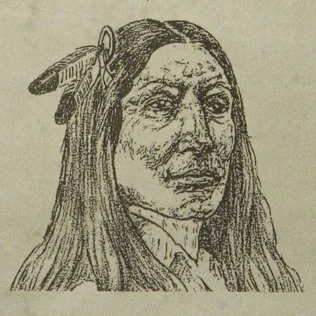
His hair was curly and light brown rather than straight and jet black. His skin was so fair, some people thought he was partly white rather than a full-blooded Miniconjou Sioux. His childhood name was Curly, but we know him today as Crazy Horse.
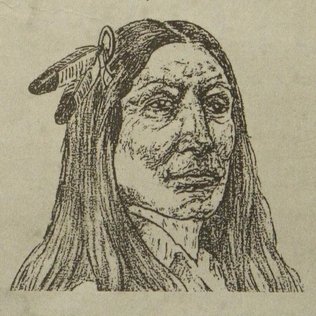
Drawing of Crazy Horse
When Curly was about 11 years old, the Miniconjou lost their head man and there was no one to talk sense to the hot-headed younger warriors. Like a gang of skinhead thugs today, they roamed the prairie along the Oregon Trail, accosting wagon trains to demand gifts of coffee and sugar. They also stole horses, which was business as usual for Plains tribes, but which whites considered a hanging offense.
The depredations of the young warriors, like skinheads today, do not arise in a vacuum. There are always deep-seated social and economic issues. For the Miniconjou, it was the loss of territory to white settlers and the destruction of the buffalo and other animals that fed the tribes. Their traditional way of life faced a threat as disruptive as the AI revolution we face today; and like today, events were moving faster than their elders could agree on how to adapt. It is important to recognize, without condoning their actions, that young people with fading prospects of social and financial advancement will become alienated and cause trouble.
The troops at Ft. Laramie were aware of the Miniconjou “problem”. Even in Washington, DC, the government was worried about a general uprising of the Sioux. To deal with the problem, in 1855, Thomas Twiss was appointed as the new Indian agent at Ft. Laramie. He was a West Point graduate, handpicked by Col. William Selby Harney, commanding officer at Ft. Laramie. Both men believed they were racially superior to Indians. They also knew that their most brutal tactics would be popular among white settlers.
Twiss sent messages to the Sioux bands that any Indian found north of the North Platte River would be shot on sight. However, few bands received his message because they were roaming the prairie on their annual buffalo hunt. Without waiting to see if they complied, Col. Harney went hunting for Indians with an expedition of 600 soldiers.
They found a Brule band engaged in their annual buffalo hunt, near Blue Water Creek (a/k/a Ash Creek) north of the Platte. A smaller band of Oglala that included Crazy Horse’s family had joined the Brule for the buffalo hunt. Harney’s troops proceeded to slaughter 86 men, women, and children, including Crazy Horse’s father. Harney then marched the female survivors to Ft. Laramie where the officers and enlisted men used them as sex workers. Today Harney would (hopefully) be prosecuted as a human trafficker.
Harney’s lop-sided “victory” was the start of thirty years of war, involving gruesome practices that today are defined as crimes against humanity, including destroying or withholding food and shelter and attacking civilians. The situation was exacerbated in 1863, when the Homestead Act opened western lands for white settlement. White settlers began setting up farms and ranches on the prairie on land that had been promised to the Indians.
Crazy Horse survived Ash Creek and joined the Oglala band led by Red Cloud. Unsurprisingly, he developed an implacable hatred of white people. Crazy Horse would become one of the great war leaders of the western bands of the Sioux (Brule, Lakota, Oglala, and Miniconjou), mentored by Red Cloud.
But he was a loner, often disappearing alone into the wilderness for weeks. Sometimes, he went hunting on his own, returning weeks later with mountains of meat. In accordance with tribal customs, the best cuts of meat were distributed to poor families, clans or villages. At other times, he drifted away to live among other tribal bands.
By the time he was 20 years old, Crazy Horse was an experienced warrior. He was suicidally brave in battle. Today, we might wonder if he had a death wish. His specialty was a maneuver the Sioux called a “dare ride” which involved a one-man charge against the enemy. His fellow warriors joked about the number of horses that were shot out from under him. A Crow warrior once stated that whenever the Lakota attacked, Crazy Horse was closer to the Crow fighters than his own comrades.
Eventually, he developed an attack formation in which he led from the front with 20 to 40 warriors spread behind him “like the wings of a hawk”. He attracted many young warriors due to his bravery and because he always planned a successful end to a fight, what we call an exit strategy.
His bravery in battle earned him an invitation to join an Oglala soldier society called the Strong Hearts. These men refused to wear any clothes or eat any food that was associated with whites. They often harassed Indian bands that traded with whites for food and clothing, threatening to kill their horses. The warrior-monk aesthetic appealed to Crazy Horse, and he rose rapidly to become the leader of the Strong Hearts.
Crazy Horse was a quiet, rather morose man. Even after he became a war leader, he rarely spoke during council meetings. He preferred wandering the prairie alone, sometimes having visions. Many tribal members believed he had magical powers because of his ability to survive his outrageously dangerous battle maneuvers.
Red Cloud relied on Crazy Horse when preparing attacks along the Bozeman Trail in Wyoming and Montana. Crazy Horse and his Strong Hearts always took on the most dangerous jobs, in the vanguard of the attack. At the height of Red Cloud’s War in the summer of 1866, Crazy Horse and the Strong Hearts wreaked havoc along the Bozeman Trail.
Their biggest success occurred on December 21, 1866, when Crazy Horse and about 20 Strong Hearts intercepted Lt. Fetterman as he led a force out of Ft. Phil Kearny to relieve a woodcutting party. The Indians lured Fetterman into a trap which ended forty minutes later with half the fighting force of Ft. Phil Kearny wiped out. Crazy Horse remained a loyal fighter for Red Cloud until 1872 when Red Cloud declared that he was through fighting.
Crazy Horse joined Sitting Bull who continued fighting. However, a war of attrition against repeating rifles and field artillery drained the life of the tribes. The official U.S. government policy, fanatically supported by white settlers, was that the only good Indian was a dead one. (Racial hatred continues to fuel the most brutal fighting around the globe today.)
In the spring of 1877, Crazy Horse turned himself in at the Red Cloud Agency. Unfortunately, the military leadership remained terrified of Crazy Horse’s reputation and respected status among the tribes. Four months after surrendering, a military detail of white soldiers and Indian reservation guards were sent to arrest him on dubious criminal charges. A scuffle ensued and Crazy Horse was bayoneted to death. His death remains one of the most controversial events of the 19th century Indian wars.
In 1948, a family of sculptors began carving a mountain in the Black Hills as a monument to Crazy Horse. When completed it will show him on horseback pointing toward tribal land. Their work is hampered by the fact that they rely on private donations because of a lack of support from the South Dakota and federal governments. Racism never dies; it just disguises itself as bureaucratic red tape. They’re still afraid of the reputation of Crazy Horse.
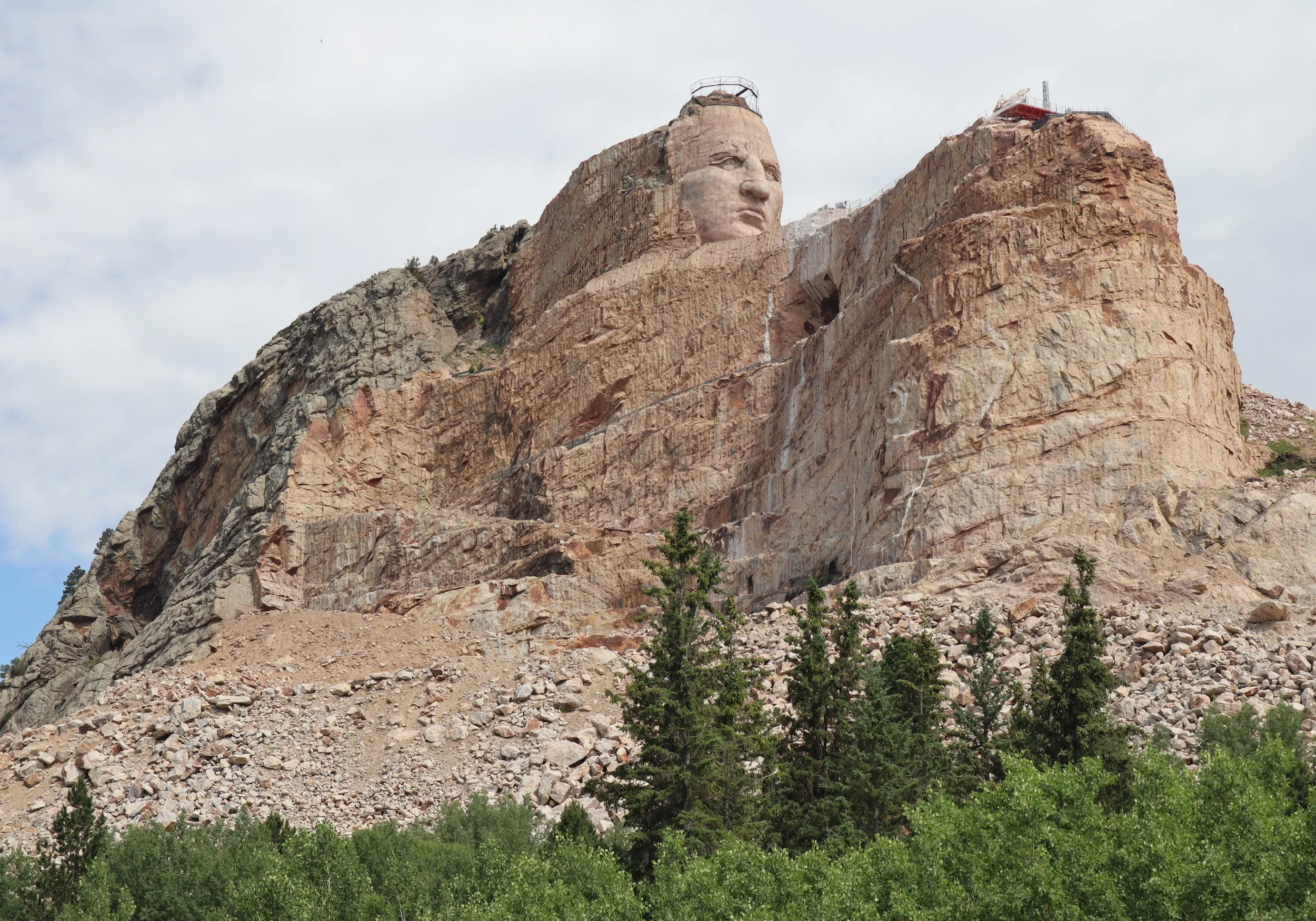
Monument dedicated to Crazy Horse
Crazy Horse is a fascinating mix of contradictions. He was kind to the weak and poor, but also an implacable, brutal fighter. He was either one of the bravest fighters ever or a suicidal loon. He was never photographed, so we have only the descriptions of those who knew him. Unlike Red Cloud and Sitting Bull, he has no known descendants. He remains a tantalizing enigma.
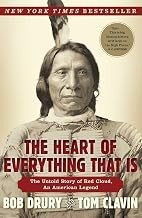
This account of Crazy Horse is taken from The Heart of Everything That Is: The Untold Story of Red Cloud, An American Legend, Bob Drury and Tom Clavin (2013)